 Agent Auto-Continue
Guide
Continue the thread or start a new one?
Published
Your agent stopped. A usage limit, a long lunch, or it just finished a step. Do you type Continue, or start fresh?
My rule: same task, same thread. New task, new thread, the moment it’s new. Anthropic’s rule of thumb is the same: start a new task, start a new session.
What a long thread costs
Everything in the thread is what the model sees: your messages, every file it read, every tool output. Anthropic calls the cost context rot: performance degrades as context grows, and older, irrelevant content starts to distract. A fresh thread costs too: for related work it rereads the files you just changed, which is slower and pricier (same post).
Same thread or new thread
| Same thread if… | New thread if… |
|---|---|
| The next message needs the earlier ones (“do the rest the same way”) | It’d make sense to a stranger (“add dark mode to settings”) |
| It stopped mid-task | The task’s done |
| It remembers the plan and what you decided | It forgets what you settled, or retries a failed fix |
It’s just long, and /compact would tidy it | It compacted and lost something you need |
One grey area: docs for the feature you just built. Anthropic’s post suggests a subagent for that; I stay put while the thread’s still sharp.
23:40, three test files to go
It’s 23:40 and Claude Code hits its session limit halfway through fixing your flaky auth tests. Four test files done, three to go.
- Continue. “Do the other three the same way” means nothing without the first four. If you’d rather not wait up, Claude Code’s built-in auto-continue picks it up in the same session after the reset (leave it open).
- Then a new thread. Next morning the migration’s merged and you want dark mode on the settings page. The auth test history only gets in the way.
Starting fresh without losing anything
- Claude Code.
/clearstarts a new conversation with empty context (/newis an alias). The old one stays:/resumebrings it back, andclaude --continuereopens the most recent one in the directory./compactsummarises but keeps the same conversation. - Codex CLI.
/newstarts a fresh chat in the same CLI session,/compactswaps earlier turns for a summary, andcodex resumereopens an earlier chat.
Claude Code also compacts by itself as context fills up, and early instructions may not survive. Anthropic’s example: after long debugging, “now fix that other warning we saw in bar.ts” lands on a summary that may have dropped it.
Before switching, ask the old thread for a handoff note and make it the new thread’s first message:
Write a handoff note for a fresh session that will pick this up.
Under 200 words: the goal, what's done, what's left,
the files that matter, what we decided
and which approaches we ruled out.
Skip what the code already says.
At a Claude Code usage limit the old thread can’t answer, so write it yourself under the same headings.
Anything every thread should know belongs in CLAUDE.md, not in the chat.
Where the app fits
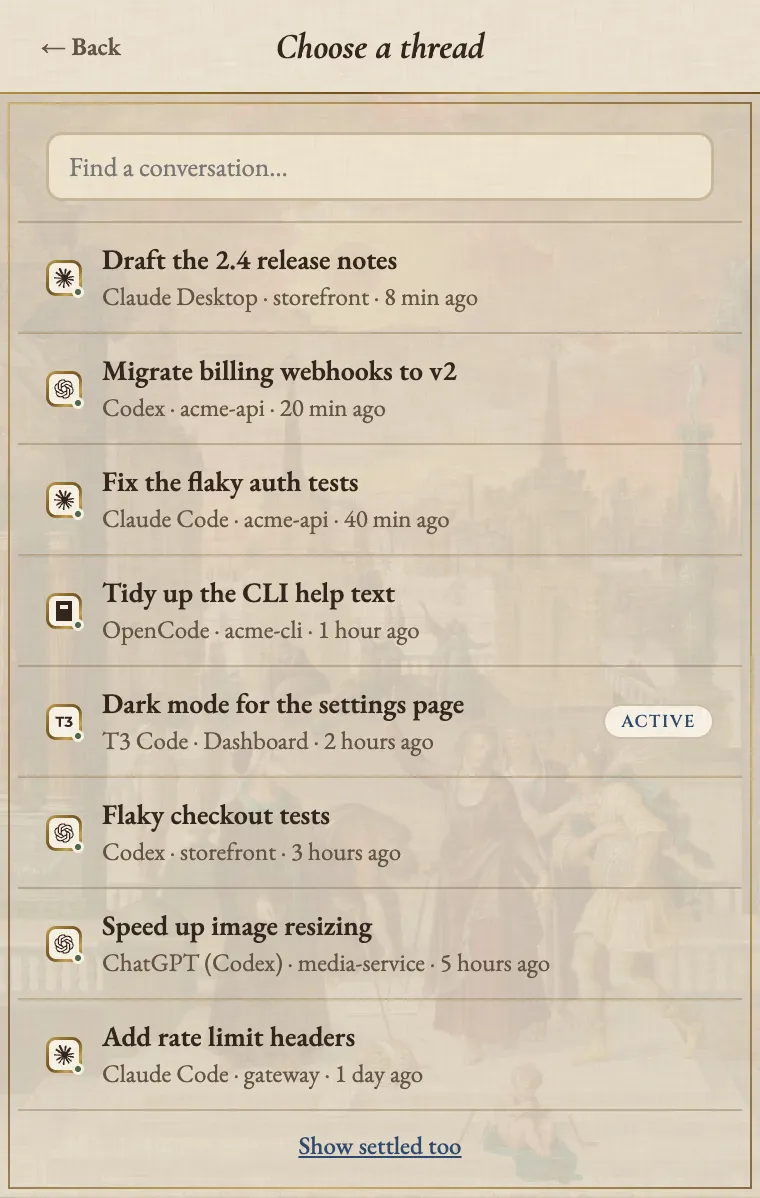
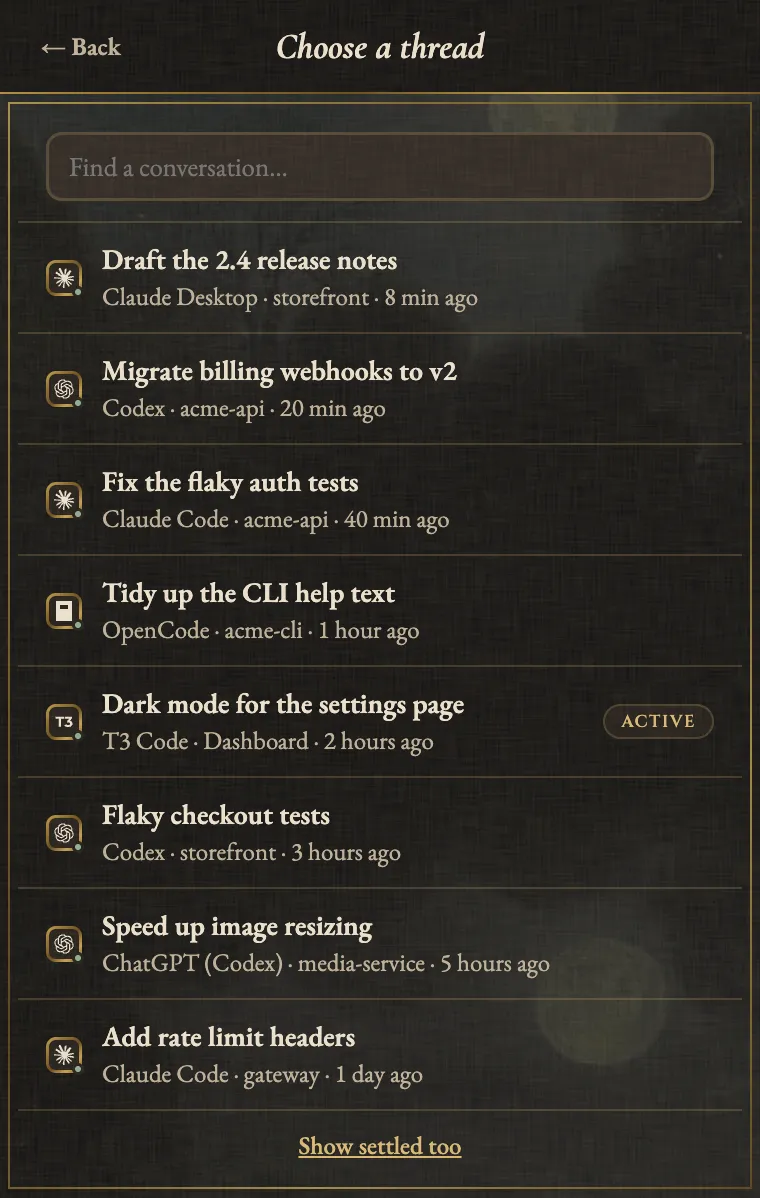
Agent Auto-Continue is a free macOS menu-bar app that sends a message into an agent’s conversation at a time you pick, or once the limit lifts. It only sends into a conversation that already exists, and never starts one.
When a fresh thread’s the right call, start it yourself with the handoff note, then pick it in the app. For what to send, see what to say instead of Continue.
What it can’t decide for you
- Whether the thread’s gone soft. That’s your call.
- Whether the task’s done. No agent reports that, so the app never guesses. A turn limit, a stop phrase or Stop ends a chain.
- That you’ve moved on. Before each send it re-checks that conversation and won’t send if it’s gone, archived or you’ve replied in it since. A reply in your new thread isn’t a reply in the old one, so cancel or stop the old schedule from its row.
Agent Auto-Continue is an independent project. It is not affiliated with, endorsed by, or supported by T3 Tools, Anthropic, OpenAI, or any other agent vendor. Product names are trademarks of their respective owners and are used only to describe compatibility.
Logo moon: Albrecht Altdorfer, The Battle of Alexander at Issus (detail of the crescent), 1529. Alte Pinakothek, Munich, inv. 688. Public domain scan, Google Art Project via Wikimedia Commons.